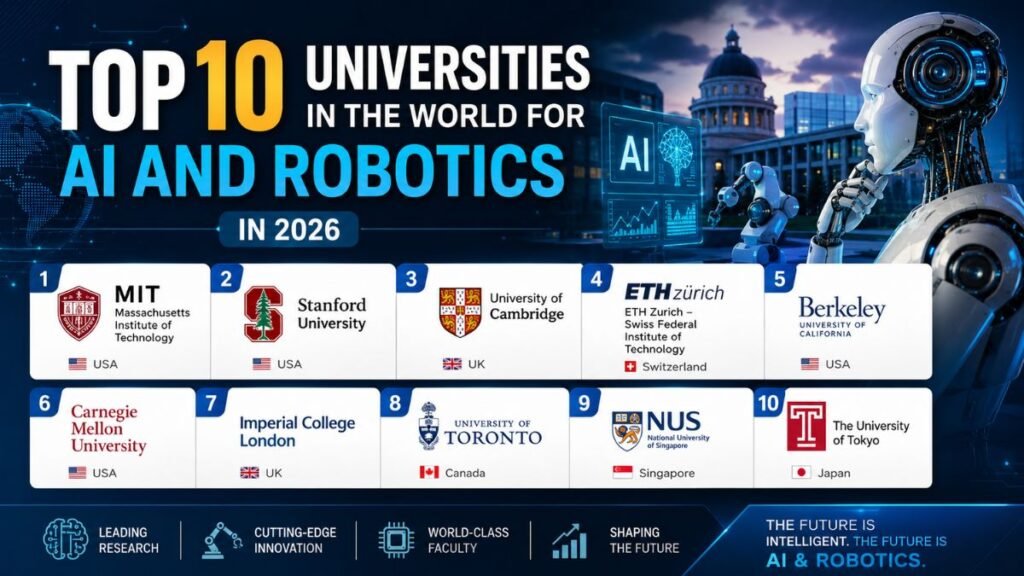
The fields of Artificial Intelligence (AI) and robotics are no longer futuristic concepts—they are actively rewriting the rules of global industry, healthcare, and software infrastructure (Chen et al., 2026; Granados, 2026). As autonomous systems and multimodal generative intelligence advance, the demand for world-class education and cutting-edge research has reached an all-time high (Rice et al., 2026).
Choosing the right institution is a defining step for students and researchers aiming to lead this next technological epoch. Based on academic reputation, research output, faculty brilliance, and breakthrough real-world applications, here are the top 10 universities in the world for AI and robotics.
1. Carnegie Mellon University (CMU) – USA
- Key Labs: Robotics Institute (RI), Language Technologies Institute (LTI)
- Specialties: Autonomous vehicles, computer vision, human-robot interaction (HRI).
Carnegie Mellon University in Pittsburgh, Pennsylvania, remains a legendary powerhouse in computing history. Having established the world’s very first Robotics Institute in 1979, CMU has consistently set global standards. Its School of Computer Science treats AI and robotics not merely as sub-disciplines, but as distinct, massive ecosystems. Students benefit from an unparalleled concentration of funding, a faculty roster filled with industry legends, and a direct pipeline to elite tech labs globally.
2. Massachusetts Institute of Technology (MIT) – USA
- Key Labs: Computer Science and Artificial Intelligence Laboratory (CSAIL)
- Specialties: Deep learning, biomimetic robotics, soft robotics, cognitive AI.
MIT’s CSAIL is arguably the most famous computing hub on earth. The institute is globally celebrated for pushing the boundaries of physical intelligence, blending mechanical engineering with cutting-edge software architecture. From designing agile, animal-inspired soft robots to pioneering foundational machine learning algorithms, MIT forces students to work at the absolute limit of theoretical physics and modern compute power.
3. Stanford University – USA
- Key Labs: Stanford Artificial Intelligence Laboratory (SAIL), Stanford Robotics Lab
- Specialties: Computer vision, natural language processing (NLP), autonomous driving, medical AI.
Positioned in the heart of Silicon Valley, Stanford University seamlessly bridges the gap between academic theory and multi-billion-dollar commercialization (Rice et al., 2026). Stanford pioneered many foundational elements of computer science and continues to lead through SAIL. The university is uniquely positioned to offer unmatched venture capital access, industry partnerships, and immediate career placement with the world’s leading tech conglomerates.
4. University of California, Berkeley (UC Berkeley) – USA
- Key Labs: Berkeley Artificial Intelligence Research (BAIR), Berkeley Robotics and Human Engineering Laboratory
- Specialties: Reinforcement learning, control theory, humanoid robotics.
UC Berkeley provides a fiercely innovative public research environment that rivals any private institution. BAIR unifies researchers across computer vision, machine learning, NLP, and robotics. Berkeley is exceptionally famous for its advancements in reinforcement learning—teaching robots to learn dynamically from their environments through trial and error—making it a premier destination for anyone interested in adaptive, intelligent machines.
5. University of Oxford – UK
- Key Labs: Oxford Robotics Institute (ORI), Department of Computer Science
- Specialties: Mobile autonomy, machine learning, computer vision, algorithmic ethics.
As one of the oldest and most prestigious universities in the world, Oxford has masterfully adapted to the digital age. The Oxford Robotics Institute (ORI) is a global leader in self-driving technology, mapping, and field robotics designed for harsh environments. Concurrently, Oxford’s computer science department places a heavy emphasis on the mathematical foundations of machine learning and the critical philosophical ethics of AI deployments.
6. ETH Zurich (Swiss Federal Institute of Technology) – Switzerland
- Key Labs: Max Planck ETH Center for Learning Systems, Robotic Systems Lab (RSL)
- Specialties: Quadrupedal locomotion, aerial robotics, neural engineering.
ETH Zurich is widely recognized as continental Europe’s premier technical institution. It is a dominant force in physical, embodied robotics, particularly famous for creating highly agile quadrupedal and walking robots capable of navigating treacherous terrains. Backed by excellent European research funding, ETH Zurich combines meticulous Swiss engineering with ultra-modern machine learning paradigms.
7. Tsinghua University – China
- Key Labs: Institute for Artificial Intelligence, State Key Lab of Intelligent Technology and Systems
- Specialties: Industrial automation, pattern recognition, hardware acceleration for AI.
Tsinghua University in Beijing is the crown jewel of Asia’s technical education. Fueled by national strategic initiatives, Tsinghua boasts massive data pools and unparalleled computing infrastructure. The university excels dramatically in deep learning, computer vision, and industrial robotics, making it a critical research engine driving global manufacturing automation and next-generation AI processors.
8. University of Cambridge – UK
- Key Labs: Cambridge Machine Learning Group, Automation and Robotics Lab
- Specialties: Probabilistic machine learning, computer vision, automated manufacturing.
The University of Cambridge treats AI and robotics with deep mathematical and scientific rigor. Famous for its foundational work in probabilistic reasoning and neural networks, Cambridge focuses heavily on creating systems that are both highly capable and robustly predictable. Its close relationship with “Silicon Fen”—Europe’s largest high-tech commercial cluster—ensures ample research grants and spin-off startup opportunities.
9. Nanyang Technological University (NTU) – Singapore
- Key Labs: Robotics Research Centre (RRC), Joint NTU-UBC Research Centre of Excellence in Active Living (LILY)
- Specialties: Collaborative robotics (cobots), urban autonomy, AI for healthcare.
NTU Singapore has rapidly ascended international rankings to become a global tech hub. Supported by Singapore’s hyper-digitalized infrastructure, NTU focuses intensely on the practical deployment of AI and robotics in urban spaces. Its research in human-robot collaboration, smart city transport systems, and automated medical care represents some of the most socially integrated engineering in the world.
10. National University of Singapore (NUS) – Singapore
- Key Labs: NUS Advanced Robotics Centre (ARC), AI Singapore
- Specialties: Soft robotics, swarm intelligence, computer vision, deep reinforcement learning.
Rounding out the top ten, NUS stands alongside NTU as a titan of Asian innovation. The Advanced Robotics Centre at NUS is highly regarded for its breakthroughs in biomimetic underwater vehicles, medical rehabilitation robotics, and swarm drone intelligence. NUS hosts multi-disciplinary initiatives that fuse mechanical engineering, medicine, and computing to solve immediate global challenges.
Direct Comparison of Top Programs
| University | Country | Standout Core Strength | Industry Integration |
| Carnegie Mellon | USA | Embodied AI & Pure Robotics | Exceptionally High |
| MIT | USA | Hardware-Software Synergy | High (Enterprise & Gov) |
| Stanford | USA | Generative AI & Computer Vision | Supreme (Silicon Valley) |
| UC Berkeley | USA | Reinforcement Learning | High |
| University of Oxford | UK | Mobile Autonomy & AI Math | High (European Tech) |
| ETH Zurich | Switzerland | Legged Locomotion & Drone Tech | High (Industrial) |
| Tsinghua University | China | Scaled AI & Automation | Supreme (National Labs) |
| Univ. of Cambridge | UK | Deep Learning Foundations | High |
| NTU Singapore | Singapore | Cobots & Urban Automation | High (Smart City Initiative) |
| NUS Singapore | Singapore | Swarm & Healthcare Robotics | High |
How to Choose the Right University for You
When planning your academic or research career in AI and robotics, a university’s global ranking is only one piece of the puzzle. Consider the following criteria:
- Hardware vs. Software Focus: If your passion lies in building physical systems (e.g., humanoids, prosthetic limbs), prioritize institutions like MIT, ETH Zurich, or CMU. If your focus is purely algorithmic (e.g., Large Language Models, computer vision software), Stanford, UC Berkeley, and Cambridge offer unparalleled digital ecosystems.
- Geographic Tech Ecosystems: Studying at Stanford or UC Berkeley puts you in the backyard of OpenAI, Google, and Apple. Choosing NTU or NUS embeds you directly into Asia’s premier digital finance and smart-nation infrastructure.
- Research Funding and Labs: Look beyond the university name and identify the specific lab or professor whose published papers align with your goals. The quality of mentorship and lab facilities often dictates your future success more than institutional prestige alone.
As AI and robotics continue to merge into unified, self-learning physical systems, graduates from these top ten institutions will remain the primary architects of tomorrow’s technological landscape.