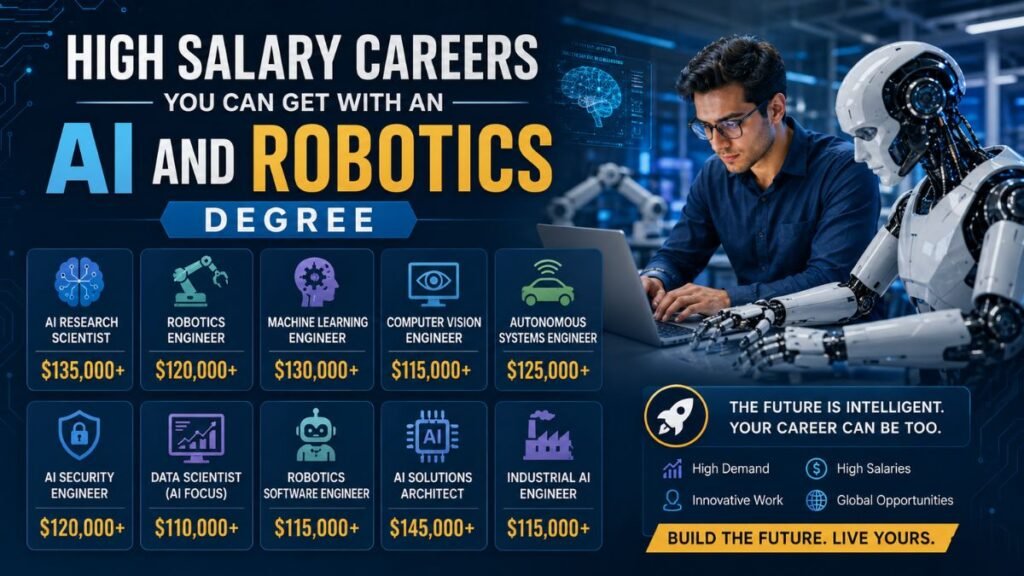
The robots aren’t just coming for our jobs—they are creating entirely new, incredibly lucrative ones.
As artificial intelligence and automation reshape global industries, the demand for professionals who can bridge the gap between software and physical machinery has skyrocketed. If you are pursuing or considering a degree in Artificial Intelligence and Robotics, you aren’t just preparing for a job; you are positioning yourself at the forefront of the next technological revolution.
But what does the financial payoff actually look like? Here is a breakdown of the highest-paying career paths you can pursue with an AI and Robotics degree, what they actually do, and why companies are willing to pay top dollar for them.
1. Machine Learning Engineer
If AI is the brain, Machine Learning (ML) Engineers are the educators. They don’t just write standard software code; they build advanced algorithms and predictive models that allow machines to learn, evolve, and make decisions from massive datasets without explicit programming.
- Why it pays well: Companies across finance, healthcare, and big tech are desperate to turn their data into automated, revenue-generating insights. ML engineers possess a rare blend of software engineering and high-level data science skills.
- Key Responsibilities: Designing ML systems, implementing appropriate ML algorithms, running tests, and optimizing models for scale and speed.
2. Robotics Engineer (Autonomous Systems)
Forget the static robotic arms assembling cars on old factory floors. Today’s robotics engineering is all about autonomous systems—think self-driving cars, warehouse drones, and surgical robots. A degree in AI and Robotics uniquely equips you to handle both the mechanical hardware and the complex AI software required to make these machines interact safely with the real world.
- Why it pays well: Building physical machines that perceive and navigate unpredictable human environments safely requires an incredibly high level of precision and multidisciplinary expertise.
- Key Responsibilities: Developing sensor-fusion algorithms, designing robotic control systems, and testing autonomous navigation in real-world scenarios.
3. Computer Vision Engineer
Ever wonder how a Tesla “sees” a stop sign, or how FaceID unlocks your phone? That is the work of Computer Vision Engineers. This niche field focuses on giving digital systems the ability to process, analyze, and understand visual data from the world (like video feeds and digital images).
- Why it pays well: From automated medical diagnostics to quality control in manufacturing, visual AI is a massive growth sector with a severe shortage of specialized talent.
- Key Responsibilities: Developing image processing algorithms, training deep learning models on visual data, and integrating cameras with robotic hardware.
4. NLP (Natural Language Processing) Engineer
If you have used ChatGPT, chatted with a virtual assistant, or used real-time translation tools, you’ve interacted with the work of an NLP Engineer. They focus on the interaction between computers and human language, teaching machines to understand, interpret, and generate text and speech naturally.
- Why it pays well: The explosion of Generative AI has made NLP one of the fastest-growing and most highly-compensated subfields in tech.
- Key Responsibilities: Designing language models, building speech recognition software, and fine-tuning large language models (LLMs) for specific industry applications.
5. AI Research Scientist
If you prefer cutting-edge theory over immediate application, becoming an AI Research Scientist might be your calling. Working in elite tech labs (like Google DeepMind or OpenAI) or academic institutions, these professionals push the boundaries of what AI can achieve, inventing entirely new architectures and learning methodologies.
- Why it pays well: Tech giants are locked in an AI arms race. The breakthroughs discovered by research scientists can translate into billions of dollars in market value.
- Key Responsibilities: Conducting rigorous academic research, publishing papers, and designing novel neural network architectures.
The AI & Robotics Salary Overview
While compensation varies wildly based on your location, experience, and the specific company, here is a general breakdown of what you can expect to earn in these roles:
| Job Title | Average Base Salary (US) | Total Comp Potential (Stock/Bonus) |
| Machine Learning Engineer | $150,000 – $185,000 | $220,000+ |
| Robotics/Autonomous Engineer | $135,000 – $165,000 | $190,000+ |
| Computer Vision Engineer | $145,000 – $175,000 | $210,000+ |
| NLP Engineer | $155,000 – $190,000 | $230,000+ |
| AI Research Scientist | $160,000 – $220,000 | $300,000+ |
Pro-Tip for High Earners: In the AI and robotics sectors, your “Total Compensation” (TC) is where the real wealth is made. Tech companies routinely offer substantial equity (stocks) and performance bonuses that can easily push your take-home pay past the $250k mark early in your career.
How to Maximize Your Earnings Potential
Simply having the degree isn’t always enough to land the highest-tier salaries. If you want to command top dollar right out of school, focus on building these specific edges:
- Master the Intersection (Hardware + Software): Pure software engineers are common. Pure mechanical engineers are common. The person who understands how a C++ script directly affects a robotic actuator’s torque? That person is a unicorn.
- Build a Portfolio of Practical Projects: Show, don’t just tell. Build your own autonomous drone, contribute to open-source ROS (Robot Operating System) projects, or deploy your own custom-trained LLM on GitHub.
- Learn to Cloud Scale: AI models are massive. Knowing how to deploy and scale your models using cloud infrastructure like AWS, Google Cloud, or Microsoft Azure makes you instantly employable.
The Bottom Line
An AI and Robotics degree is one of the most future-proof investments you can make in your education. By combining the digital smarts of artificial intelligence with the physical capabilities of robotics, you position yourself to solve some of the world’s most complex problems—and get paid exceptionally well to do it.