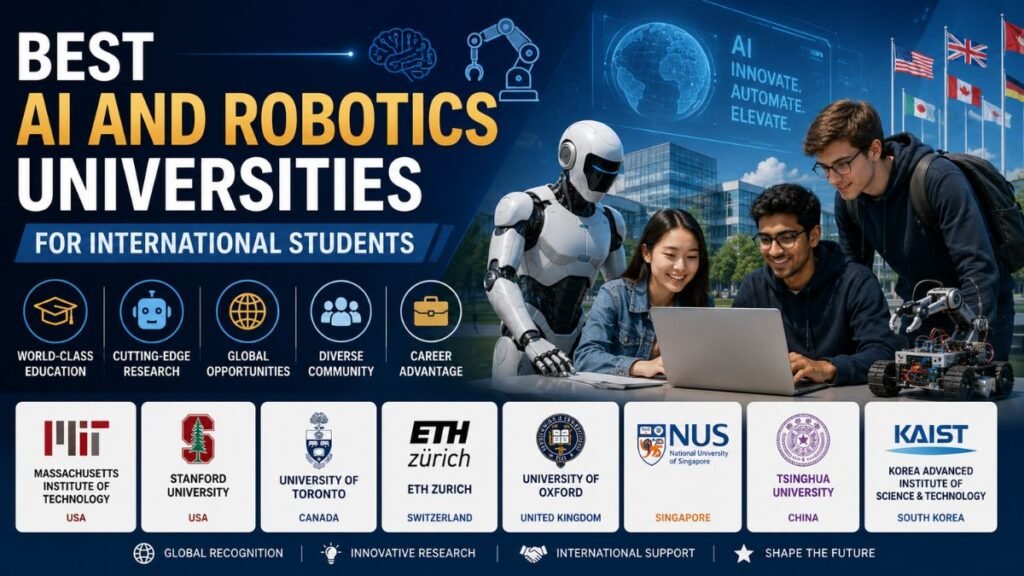
The global demand for artificial intelligence (AI) and robotics experts is skyrocketing. From autonomous vehicles and smart manufacturing to generative AI models that rewrite how we work, automation is no longer a future concept—it is the current economic engine.
For international students, choosing the right university to pursue a degree in AI or robotics is a massive decision. It requires balancing academic prestige, cutting-edge laboratory access, research funding, post-graduation work visas, and tuition costs.
This comprehensive guide breaks down the world’s elite institutions for AI and robotics, detailing what makes them stand out and how international applicants can navigate the selection process.
Why Study AI and Robotics Abroad?
Before diving into the top schools, it’s essential to understand what international programs offer over local alternatives:
- Access to Multi-Million Dollar Labs: Elite universities partner with tech giants like Google, NVIDIA, and Boston Dynamics, giving students access to state-of-the-art hardware and simulation software.
- Post-Study Work Pathways: Countries like the US, UK, and Germany offer robust post-study work visas (e.g., the STEM OPT extension in the US), allowing graduates to secure high-paying jobs in top tech hubs.
- Global Networking: Studying abroad places you in a melting pot of global talent, connecting you with future founders, researchers, and venture capitalists.
Top AI and Robotics Universities: The Global Elites
1. Carnegie Mellon University (CMU) – USA
Widely regarded as the birthplace of artificial intelligence, CMU’s School of Computer Science houses the world-renowned Robotics Institute (RI).
- Why It Stands Out: CMU was the first university to offer a dedicated Ph.D. in Robotics and an undergraduate major in Artificial Intelligence. Its research spans across computer vision, human-robot interaction (HRI), and autonomous systems.
- Key Laboratories: The National Robotics Engineering Center (NREC), which works heavily on commercial and defense-related autonomous vehicle applications.
- International Student Advantage: High industry recruitment rates. Tech companies actively scout CMU graduates, making it easier to transition to an H-1B visa pathway in the US.
2. Massachusetts Institute of Technology (MIT) – USA
MIT consistently ranks at the top of global engineering leaderboards. The MIT Computer Science and Artificial Intelligence Laboratory (CSAIL) is one of the largest and most influential research hubs in the world.
- Why It Stands Out: MIT focuses heavily on the intersection of hardware and theory. Whether you want to develop the next generation of humanoid robots or advance deep learning frameworks, MIT provides unparalleled resources.
- Key Innovations: CSAIL is famous for pioneering work in public-key cryptography, the internet’s infrastructure, and cutting-edge soft robotics.
- International Student Advantage: MIT’s “Need-Blind” admission policy extends to international students, meaning your financial situation won’t hurt your chances of acceptance, and they meet 100% of demonstrated financial need.
3. Stanford University – USA
Located in the heart of Silicon Valley, Stanford bridges academic excellence with entrepreneurial venture capital. The Stanford Artificial Intelligence Laboratory (SAIL) has been a driving force in AI since 1962.
- Why It Stands Out: If your goal is to launch an AI startup, Stanford is the place to be. It has a deeply integrated ecosystem with nearby tech giants and venture capital firms on Sand Hill Road.
- Key Focus Areas: Natural Language Processing (NLP), computer vision, and medical robotics (such as robotic-assisted surgeries).
- International Student Advantage: Unmatched networking opportunities and access to Silicon Valley internships during Curricular Practical Training (CPT).
4. Technical University of Munich (TUM) – Germany
For students seeking world-class education without the staggering price tag of US universities, Germany’s TUM is a premier choice.
- Why It Stands Out: TUM is a pillar of Germany’s “Industry 4.0” initiative, which focuses heavily on smart manufacturing, industrial automation, and cognitive systems.
- Key Programs: Master of Science in Robotics, Cognition, Intelligence.
- International Student Advantage: Tuition-free education (or exceptionally low fees compared to the US/UK) for international students, alongside Germany’s generous 18-month post-study visa to look for a job. Many advanced programs are taught entirely in English.
5. University of Oxford & University of Cambridge – UK
The UK’s “Oxbridge” institutions boast some of the oldest and most prestigious research groups in Europe, notably the Oxford Robotics Institute (ORI) and Cambridge’s Machine Learning Group.
- Why It Stands Out: Oxford and Cambridge excel in the theoretical foundations of AI, machine learning algorithms, and mobile robotics. The UK is also home to Google DeepMind, which maintains deep ties with these institutions.
- International Student Advantage: The UK’s Graduate Route visa allows international students to stay and work for two years (three years for Ph.D. graduates) after finishing their degrees.
6. ETH Zurich – Switzerland
As one of the top-ranked universities in continental Europe, ETH Zurich is a powerhouse for engineering and technology.
- Why It Stands Out: The ETH RobotX initiative brings together world-class research in autonomous drones, quadrupedal robots (like ANYmal), and machine learning theory.
- International Student Advantage: Relatively low tuition fees, high standard of living, and proximity to major European tech hubs. Switzerland is highly welcoming to top-tier research talent.
Comparison Table for International Applicants
| University | Country | Estimated Annual Tuition (International) | Post-Study Work Availability | Primary Focus |
| Carnegie Mellon University | USA | $55,000 – $65,000 | Yes (Up to 3 Years via STEM OPT) | Applied Robotics & AI Degrees |
| MIT | USA | $60,000+ (Excellent Financial Aid) | Yes (Up to 3 Years via STEM OPT) | Deep Learning & Soft Robotics |
| Stanford University | USA | $57,000 – $62,000 | Yes (Up to 3 Years via STEM OPT) | AI Startups, Computer Vision, NLP |
| TUM | Germany | Nominal Fees to $4,000/year | Yes (18 Months to find a job) | Industrial Automation, Cyber-Physical Systems |
| University of Oxford | UK | £35,000 – £45,000 | Yes (2-Year Graduate Visa) | AI Ethics, Machine Learning, Mobile Tech |
| ETH Zurich | Switzerland | $1,500 – $2,000 | Yes (6 Months post-graduation) | Drones, Quadrupedal Robotics, Algorithms |
Key Criteria for Choosing a Program
When narrowing down your list, look beyond global university rankings. Consider these operational factors:
Curriculum Balance: Theory vs. Application
Some universities treat AI as a subset of mathematics and pure computer science (focusing on algorithms and statistical models). Others view it through an engineering lens (building physical robots, sensors, and actuators). Determine whether you want to write code for neural networks or assemble physical autonomous hardware.
Industry Partnerships and Internships
Look for universities with strong corporate sponsorship. If a school frequently collaborates with companies like Amazon Robotics, Meta AI, or Siemens, it ensures that your curriculum remains relevant to the market and opens direct doors for internships.
Cost of Living and Funding
While US institutions offer incredible prestige, they come with high tuition and living costs. European options like Germany or Switzerland provide affordable or tuition-free alternatives with equally high academic standards, though competition for admission is fiercely bottlenecked.
Admission Tips for International Students
Getting into these top-tier programs requires an exceptional application portfolio. Here is what selection committees look for:
- Strong STEM Foundation: High grades in multi-variable calculus, linear algebra, probability, and proficiency in programming languages like Python and C++.
- Research or Project Portfolio: Don’t just list your classes. Highlight personal projects, GitHub repositories, or research papers you’ve contributed to involving machine learning or ROS (Robot Operating System).
- Targeted Letters of Recommendation: Secure recommendations from professors or industry mentors who can specifically attest to your problem-solving abilities and technical competency in coding or engineering.
- Clear Statement of Purpose (SOP): Explain exactly what sub-field of AI or robotics interests you, which professors at the university you want to work with, and why their specific labs match your career goals.
Final Thoughts
The field of AI and robotics is evolving faster than textbooks can keep up. Choosing a university that not only teaches the fundamentals but sits at the cutting edge of active research is paramount. Whether you choose the entrepreneurial spirit of Silicon Valley, the rigorous research labs of Pittsburgh, or the industrial powerhouse programs of Germany, a degree from an elite international institution will place you at the forefront of the technological revolution.