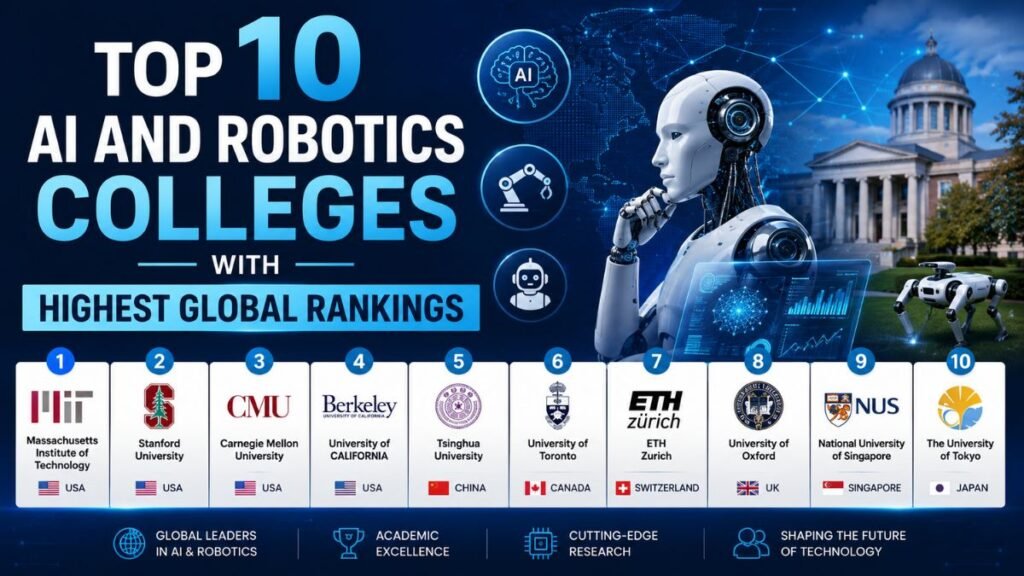
Artificial Intelligence (AI) and robotics are no longer concepts reserved for science fiction. Driven by the Fourth Industrial Revolution (Industry 4.0), these fields have completely redefined sectors like healthcare, manufacturing, defense, and logistics (Tech, 2023). For students and researchers aiming to be at the forefront of this revolution, selecting an elite academic institution is paramount.
Global university ranking bodies, such as the QS World University Rankings and Times Higher Education (THE), place a heavy emphasis on research output, citation frequency, and institutional reputation in computer science and engineering when evaluating tech-centric universities. Based on global performance indicators and academic prestige, here is the definitive list of the top 10 AI and robotics colleges in the world.
1. Massachusetts Institute of Technology (MIT) — USA
- Global Standing: Consistently ranked #1 in the world for Computer Science and Engineering by global ranking bodies.
- Key Facilities: MIT Computer Science and Artificial Intelligence Laboratory (CSAIL).
MIT is globally recognized as the pinnacle of technological innovation. CSAIL is one of the largest and most influential research centers in the world, pioneering breakthroughs in natural language processing, computer vision, and autonomous systems. MIT’s interdisciplinary approach allows robotics students to collaborate seamlessly across mechanical, electrical, and cognitive science domains.
2. Carnegie Mellon University (CMU) — USA
- Global Standing: Holds the top tier for global reputation in computer science and specialized AI programs.
- Key Facilities: The Robotics Institute (RI).
CMU established the world’s very first Robotics Institute in 1979, and it remains an unmatched global powerhouse (Bao et al., 2018). It is one of the few institutions offering a dedicated undergraduate degree in Artificial Intelligence. RI’s research covers everything from biomimetic robots and lunar rovers to advanced machine learning models, making CMU a prime recruiting ground for Silicon Valley.
3. Stanford University — USA
- Global Standing: Top 3 globally in academic and employer reputation.
- Key Facilities: Stanford Artificial Intelligence Laboratory (SAIL).
Located in the heart of Silicon Valley, Stanford bridges the gap between elite academic theory and industry application. SAIL, led by legendary figures over the decades, has been foundational to the development of modern deep learning and neural network architectures. Stanford’s close ties to companies like Google, Apple, and OpenAI provide students with unparalleled networking and internship pipelines.
4. University of Oxford — UK
- Global Standing: Consistently ranked #1 or #2 overall in the Times Higher Education World University Rankings.
- Key Facilities: Oxford Robotics Institute (ORI) and the Department of Computer Science.
Oxford combines centuries of academic prestige with cutting-edge tech research. The Oxford Robotics Institute focuses heavily on mobile robotics, autonomous vehicles, and machine-to-machine coordination. Furthermore, Oxford plays an essential role in the UK’s broader ecosystem alongside institutions like the Alan Turing Institute, reinforcing its status as a global research hub (Hall, 2017).
5. University of California, Berkeley (UC Berkeley) — USA
- Global Standing: Top-ranked public university globally; exceptionally high citation count in AI publications (Bao et al., 2018).
- Key Facilities: Berkeley Artificial Intelligence Research (BAIR) Lab.
UC Berkeley’s BAIR Lab brings together over several dozen faculty members and hundreds of graduate students across computer vision, machine learning, natural language processing, and robotics. Berkeley is particularly famous for its contributions to open-source AI frameworks and foundational advancements in reinforcement learning.
6. ETH Zurich — Switzerland
- Global Standing: Top 10 globally in QS World University Rankings; highest-ranked university in continental Europe.
- Key Facilities: Institute for Robotics and Intelligent Systems (IRIS) and the ETH AI Center.
ETH Zurich is renowned for its rigid technical excellence. IRIS conducts world-class research in bio-robotics, micro-robotics for medical applications, and autonomous aerial vehicles (drones). ETH Zurich benefits from Switzerland’s massive investments in tech research, making it a dream destination for international students looking for a European hub (Bao et al., 2018).
Global Comparison Matrix
| College / University | Country | Key Research Focus | Top-Tier Facility |
| MIT | USA | Autonomous Systems, NLP, Vision | CSAIL |
| Carnegie Mellon University | USA | Computer Science, Cognitive AI, Biomimetics | The Robotics Institute |
| Stanford University | USA | Deep Learning, Computer Vision | SAIL |
| University of Oxford | UK | Mobile Robotics, Autonomous Driving | Oxford Robotics Institute |
| UC Berkeley | USA | Reinforcement Learning, Open-Source AI | BAIR Lab |
| ETH Zurich | Switzerland | Medical Micro-Robotics, Drones | IRIS |
| Tsinghua University | China | Deep Learning, Intelligent Manufacturing | Institute for AI |
| National University of Singapore | Singapore | Human-Robot Collaboration, Medical Tech | NUS Advanced Robotics Centre |
| University of Cambridge | UK | Machine Learning, Computer Vision | Automated Reasoning Group |
| Imperial College London | UK | Surgical Robotics, Cognitive Robotics | Dyson Robotics Lab |
7. Tsinghua University — China
- Global Standing: Ranked among the absolute top institutions in Asia for engineering and technology.
- Key Facilities: Institute for Artificial Intelligence.
Tsinghua University acts as the primary engine for China’s ambitious national AI development goals (Wu et al., 2017). It generates massive publication volumes in premier AI conferences. The university’s robotics research is heavily focused on practical applications, including industrial automation, intelligent manufacturing, and smart transportation infrastructure (Zhu, 2026).
8. National University of Singapore (NUS) — Singapore
- Global Standing: Consistently ranks in the top 10 to 15 globally in the QS World Rankings.
- Key Facilities: NUS Advanced Robotics Centre (ARC).
NUS is the jewel of Southeast Asian tech education. The Advanced Robotics Centre targets real-world industrial challenges, focusing heavily on human-robot collaboration, autonomous marine vehicles, and healthcare assistive robotics. Backed by heavy state funding, NUS boasts state-of-the-art facilities and an incredibly international faculty.
9. University of Cambridge — UK
- Global Standing: Top 5 overall global ranking.
- Key Facilities: Machine Learning Group and the Department of Engineering.
Like its rival Oxford, Cambridge excels in the theoretical underpinnings of artificial intelligence. Its researchers have done groundbreaking work in probabilistic machine learning, computational linguistics, and computer vision. The Dyson Centre for Engineering Design also provides student robotics teams with cutting-edge spaces to prototype and test autonomous hardware.
10. Imperial College London — UK
- Global Standing: Top 10 global ranking, highly acclaimed for specialized engineering.
- Key Facilities: Dyson Robotics Laboratory.
Imperial College London offers an intensely practical, engineering-driven curriculum. The Dyson Robotics Laboratory focuses on computer vision algorithms that allow robots to process and map 3D spaces in real-time. Imperial is also an international leader in medical and surgical robotics, creating precision tools used by doctors worldwide.
What Makes These Colleges Stand Out?
When ranking these institutions, global bodies look beyond classroom curricula. The schools that dominate the rankings share common traits:
- High Citation Impact: Their faculty members publish papers that are cited thousands of times across top peer-reviewed journals like Science Robotics and IEEE Transactions on Robotics (Zhu, 2026).
- Industry Ecosystems: They are located in high-tech clusters (e.g., Silicon Valley, London, Zurich, Singapore), allowing students to transition instantly into lucrative corporate or startup roles (Bredt, 2019).
- Massive Research Funding: They secure billions in grants from both public institutions and private tech giants, ensuring students work with the most advanced hardware available.
Summary
Choosing a college for AI and robotics requires balancing academic prestige with practical laboratory access. Whether you aim for the legendary entrepreneurial culture of Stanford, the unmatched algorithmic rigor of CMU, or the European engineering precision of ETH Zurich, graduating from any of these top 10 institutions guarantees a spot at the cutting edge of global innovation.